Are modern log burners environmentally friendly?
Air pollution and carbon are different questions
Discussions about log burners often combine two separate environmental issues.
- Local air quality: Burning wood releases fine particulate matter and other combustion pollutants near homes and communities.
- Climate impact: the result depends on the source of the wood, woodland management, processing, transport, alternative uses and the time needed for regrowth.
Government statistics published in February 2026 reported that domestic combustion contributed 20% of UK PM2.5 emissions in 2024. The detailed release states that most recent domestic-combustion particulate emissions came from households burning wood indoors. It also reports that total PM10 and PM2.5 emissions from domestic combustion fell by 26% between 2018 and 2024.
Those national figures cover a mixture of appliances, fuels and user behaviour. They do not mean every stove performs in the same way, but they show why appliance design, fuel quality and operation matter.
For a closer look at competing claims, read our article on misinformation and negative press around wood-burning stoves.
Why an open fire and a modern stove are not the same
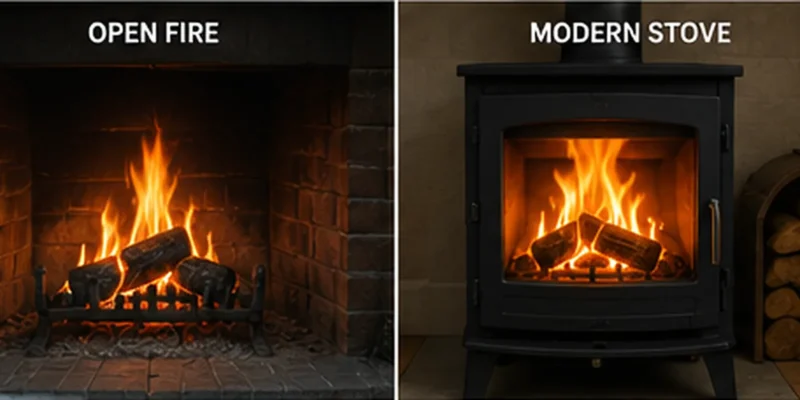
An open fire allows a large volume of room air to pass into the chimney and gives limited control over combustion. Much of the useful heat can escape. A closed stove controls the fuel load and airflow more carefully while transferring heat through the appliance body and glass.
New solid-fuel local space heaters placed on the market have had to meet Ecodesign requirements since 1 January 2022. These requirements set appliance performance and emission limits. Ecodesign compliance does not automatically mean a stove is approved to burn wood in every smoke control area.
A modern stove can still be operated poorly. Wet logs, overloading, prolonged smouldering, poor draught or blocked ventilation can undermine its design advantages.
Nine ways to reduce smoke and burn more responsibly
-
Ask whether you need to light it
Avoid burning from habit when the room is already warm. Use the stove when it provides a genuine heating benefit.
-
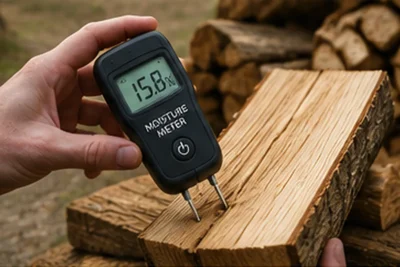
Use wood with 20% moisture or less
Defra advises burning dry wood at or below 20% moisture. Wet wood wastes heat evaporating water and creates more smoke, particles and tar.
-
Test the freshly split centre
The outside can feel dry while the middle remains damp. Split a log and press the meter pins into the newly exposed face.
-
Look for Ready to Burn fuel
For smaller quantities sold for domestic use in England, the Ready to Burn mark provides assurance that the supplied wood meets the moisture requirement.
-
Choose the right heat output
An oversized stove may be run too slowly because it overheats the room. Start with our kilowatt calculator, then confirm the result professionally.
-
Light from the top
A top-down fire can warm the flue quickly and reduce the need to disturb the fuel while it establishes.
-
Do not make the stove smoulder
Closing the controls too far can increase incomplete combustion, darken the glass and create deposits.
-
Maintain the appliance and chimney
Regular sweeping and servicing keep the combustion route clear and help identify worn or damaged components.
-
Never burn treated timber or rubbish
Painted wood, furniture, MDF, plastics and household waste can release harmful pollutants and damage the stove or flue.
Does locally sourced wood make a difference?
Shorter transport may reduce one part of the fuel’s footprint, but “local” does not automatically mean dry, untreated or sustainably managed. Ask about the source, moisture, seasoning and storage.
Hardwood is not automatically cleaner than softwood. Both can burn effectively when properly dried and used in a suitable appliance. Softwood tends to ignite and burn more quickly, while dense hardwood often provides a longer burn. Moisture and operation are more important than a simple species rule.
Can you burn wood in a smoke control area?
In a smoke control area, unauthorised fuels such as wood can only be burned in an exempt appliance, and only in the way and with the fuels its approval permits. Do not assume a stove described as “Ecodesign” is automatically smoke exempt.
GOV.UK provides a summary of smoke control area rules. Defra also provides information about smoke control areas and exempt appliances.
Ecodesign and Defra exemption are not interchangeable
Ecodesign concerns product performance requirements. Defra exemption concerns whether a particular appliance may burn an otherwise unauthorised fuel in a smoke control area, subject to its conditions.
Is a log burner the greenest way to heat a whole home?
A room stove and a whole-home heating system do different jobs. A log burner can provide strong local heat and reduce demand on another system in the room being used. It does not normally provide even whole-home heat, hot water or automatic control.
If your main goal is lower whole-home energy use and carbon emissions, start with the building. Insulation, draught control and effective heating controls reduce the heat required. For some homes, a properly designed heat pump may offer a lower-carbon whole-home route because it moves heat rather than producing it through combustion.
| Your priority | Questions to ask |
|---|---|
| Local room heat and a real flame | Is wood burning appropriate locally? Is there a suitable chimney or flue? Can you store dry fuel? |
| Low-maintenance flame effect | Would an electric fire or stove provide the atmosphere and occasional heat you need? |
| Real flame with quick control | Would a gas stove or fire suit the property and your preferred level of control? |
| Whole-home low-carbon heating | What insulation is needed, and could a heat pump or other system meet the design heat loss? |
Frequently asked questions
Are log burners being banned?
There is no simple UK-wide answer that applies to every existing stove. Rules concerning smoke control areas, appliance approvals and fuel already affect use. Check current official guidance for the property and appliance.
Is kiln-dried wood better than seasoned wood?
Either can burn well if untreated and at 20% moisture or less. The measured moisture matters more than the marketing description.
Is a modern stove cleaner than an open fire?
A modern closed stove provides more control and can perform far better than an open fire, but it still produces combustion emissions.
Is burning wood carbon neutral?
It should not automatically be described that way. Climate impact depends on sourcing, management, processing, transport, alternative use and regrowth.
What is the cleanest way to use a log burner?
Use it only when useful, burn dry untreated wood, choose a suitable modern appliance, avoid smouldering and maintain the stove and chimney.
Choose a stove that suits the room and how you will use it
Compare modern wood-burning stoves, outputs and installation options with Knight Stoves.